Swing Strategies
Swing trade the natural waves of market momentum, capturing price surges in weeks rather than waiting years. This active approach outpaces passive investing by compounding gains more frequently without constant screen monitoring.
Trade the Market's Rhythm
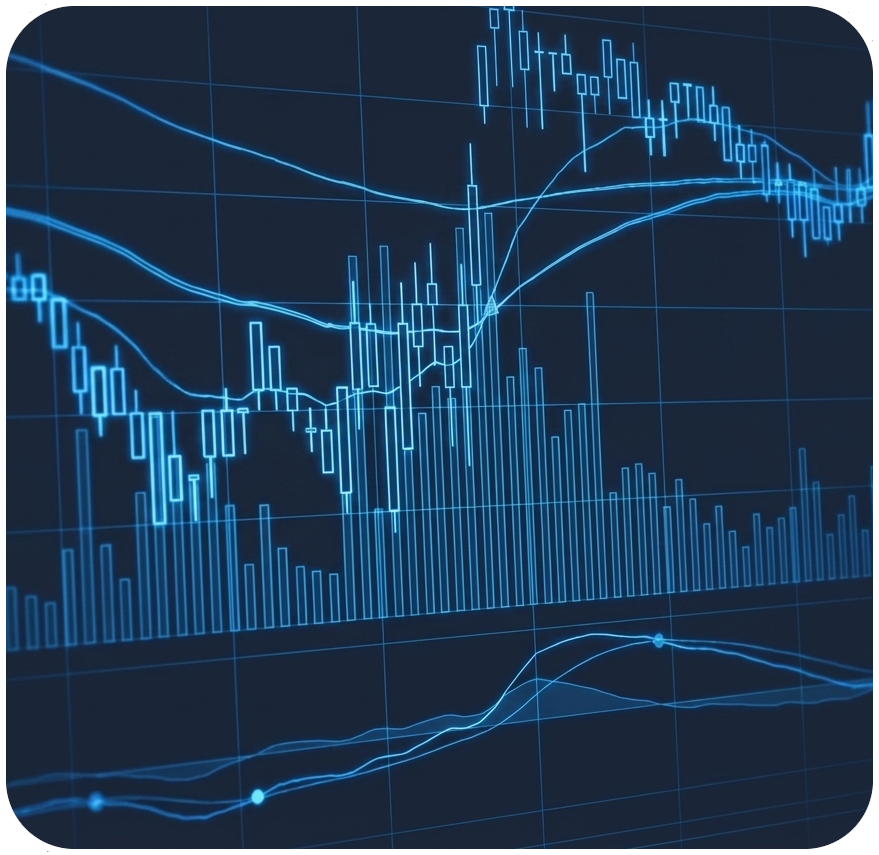
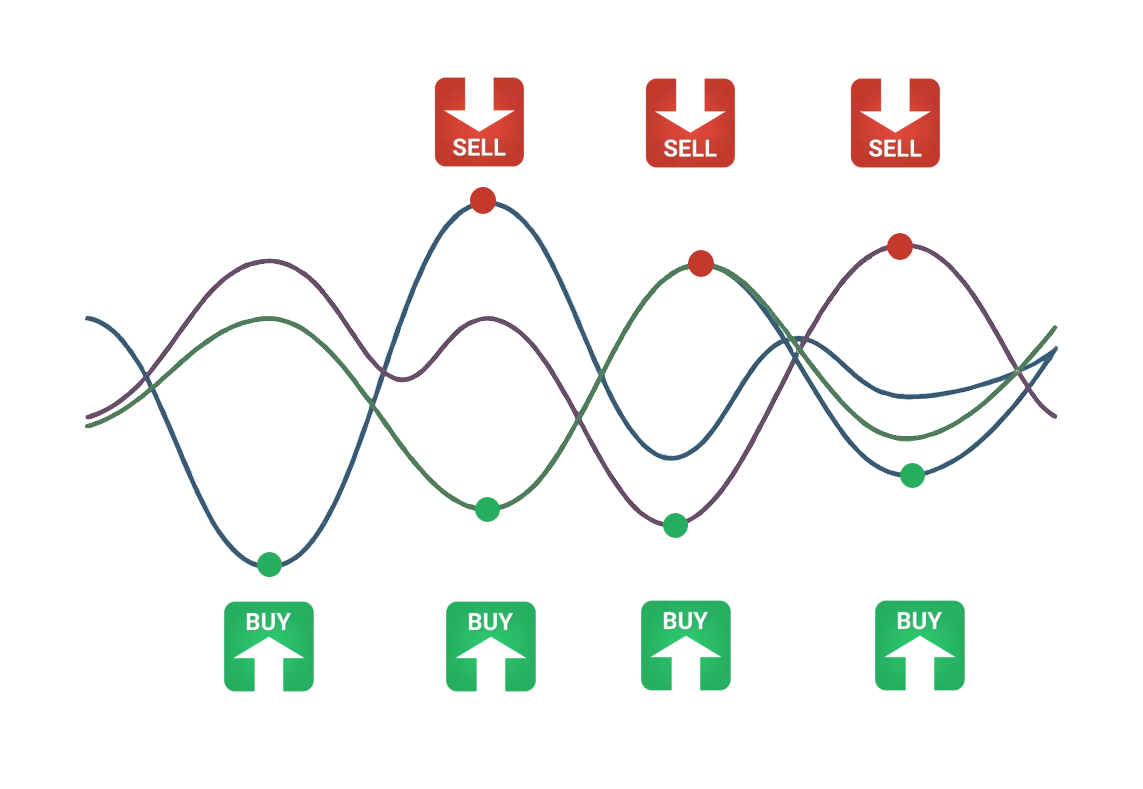
Markets move in predictable waves—rising and falling as investor sentiment shifts between optimism and caution. Within every trend lies a series of peaks and troughs that create repeatable trading opportunities. Recognizing these patterns allows disciplined traders to enter positions near the bottom of a wave and exit near the top, capturing gains that passive investors never see.
A traditional "buy and hold" strategy ignores this natural rhythm entirely. While you wait months or years for your investment to appreciate, swing traders are actively harvesting profits from each wave. Even in a year where a stock ends flat, the waves between the highs and lows can generate substantial returns for those who know when to act.
Swing trading transforms market volatility from a risk into an opportunity. By making short-term trades aligned with the natural ebb and flow of price action, you can compound gains more frequently—accelerating your path to financial growth without needing to predict where the market will be a year from now.
Active vs Passive Investing
Standard wealth-building advice is designed for the passive passenger — someone willing to wait 40 years for the market to do the heavy lifting. However, for the active investor, the value proposition shifts from "waiting" to "accelerating."
It's the difference between riding the bus (Index Funds) and driving the car (Swing Trading).
"Park your money and wait. The Rule of 72 says you'll double your money every 7–9 years."
You don't wait for the market to give you 8% over a year; you aim to capture that 8% in a few weeks during a momentum surge, then free up that capital to do it again.
The Edge: By rotating your capital into assets that are currently moving, you increase the frequency of compounding, potentially compressing decades of gains into years.
"Buy the whole haystack (Index Funds) so you don't miss the needle."
"Only hold the needles." Swing traders use market intelligence to filter out lagging sectors and focus capital solely on high-performance assets while they are trending.
The Edge: You avoid the "dead weight" of underperforming companies that drag down index fund returns.
"When the market crashes, just hold on and wait for it to recover."
Agility. A swing trader has a predefined exit plan (Stop Loss). When the trend breaks, you move to cash.
The Edge: You don't have to suffer through a 20% bear market drawdown. By stepping aside during corrections, you preserve your capital so you can buy back in at the bottom.
"Buy on the 1st of the month, regardless of price."
Efficiency. Why buy when a stock is overextended? Swing traders wait for the "pullback" to a key support level to enter.
The Edge: You get more shares for your money and a tighter risk profile. You are buying when the odds are mathematically in your favor.
"Hope the market goes up over the long run."
Mathematical Control. Every trade starts with a calculation: "I am risking $1 to make $3." If the trade fails, the loss is small and controlled.
The Edge: You treat trading as a business with managed costs, rather than a gamble on the future economy.
The Swing Trading Edge
Eliminating Fee Drag
By managing your own trades, you avoid paying expensive 1%–1.5% management fees to a middleman. Over time, keeping that money in your account allows your savings to grow much larger. In today's market, you can trade for nearly $0, ensuring your profits stay with you, not a fund manager.
Moving Capital Faster
Swing trading lets you capture 5% to 10% gains in a few days or weeks, then move that money into the next opportunity. Instead of waiting years for a stock to grow, you "recycle" your cash multiple times a year. This faster pace can help your wealth build up much quicker.
Lowering Your Risk
By making multiple small investments instead of one "big bet," you protect yourself from heavy losses. If one stock drops, it only affects a tiny part of your total money. This makes it easier to stay calm, admit when a trade isn't working, and move on without feeling a "sting."
Better Agility
Small traders can move much faster than big banks or mutual funds. You can jump into a rising trend or exit a failing industry in seconds. This flexibility helps you avoid "value traps" and find better ways to grow your money faster than the rising cost of living.
Definitions & Methodology
1 Fee Drag: The cumulative impact of management fees on investment returns over time. A 1.5% annual fee can reduce your portfolio value by 25-30% over a 20-year period compared to self-directed investing.
2 Capital Velocity: The rate at which trading capital is recycled through profitable opportunities. Higher velocity means more compounding events per year, potentially accelerating wealth accumulation.
3 Position Sizing: The practice of limiting each trade to a small percentage of total capital (typically 1-5%) to minimize the impact of any single losing trade on overall portfolio performance.